
.png)
Making Charcoal out of Hay!
- Philipp Baumann
- May 13
- 4 min read

Making Charcoal out of Hay?
This new project is again for Madagascar, but it's quite a bit different from the last one that I have been involved with. We are currently trying to find an alternative for Wooden Charcoal.
It is estimated that Madagascar has as little as 10 percent of its original forest left and that between the year 2000 and 2020 about 4.8 million hectares of forest have been cut down, this compares to an area that is bigger than Switzerland!
Most of the Wood is used for firewood and charcoal, as up to 98% of the 30 million people are relying on these fuels to cook their meals on every day. Using charcoal is partly rooted in cultural practises, but most people depend on it for survival as for alternatives like gas and electric stoves, the infrastructure, and finances are missing.
Cooking in Madagascar happens mainly on very simple Malagasy stoves like the one on the picture. They are simple, but not really efficient. Many attempts have already been made from various Organisations and people groups, with more advanced stoves to save wood and charcoal. Even alternatives using the power of the sun are being tested.
Sadly, many good ideas don’t stand the test of reality and do not last as people will go back to their old ways, for reasons as simple as preference or because it is easier. Also, if not subsidised, it’s impossible for the people to buy these more efficient but also much more expensive stoves. One of the simple Malagasy stoves costs only around 2 Euros, but this is already a day's wage of a Malagasy person.
As a small team, we have now been trying to find a solution that could be applied easily to maximise the chance of success. After a lot of research, brainstorming and testing various ideas, we think we have arrived at a solution that could work.
We are now carbonising Hay, that is, burning off everything from the hay until mainly carbon is left. The same process called pyrolysis is also being used for turning wood in to charcoal.
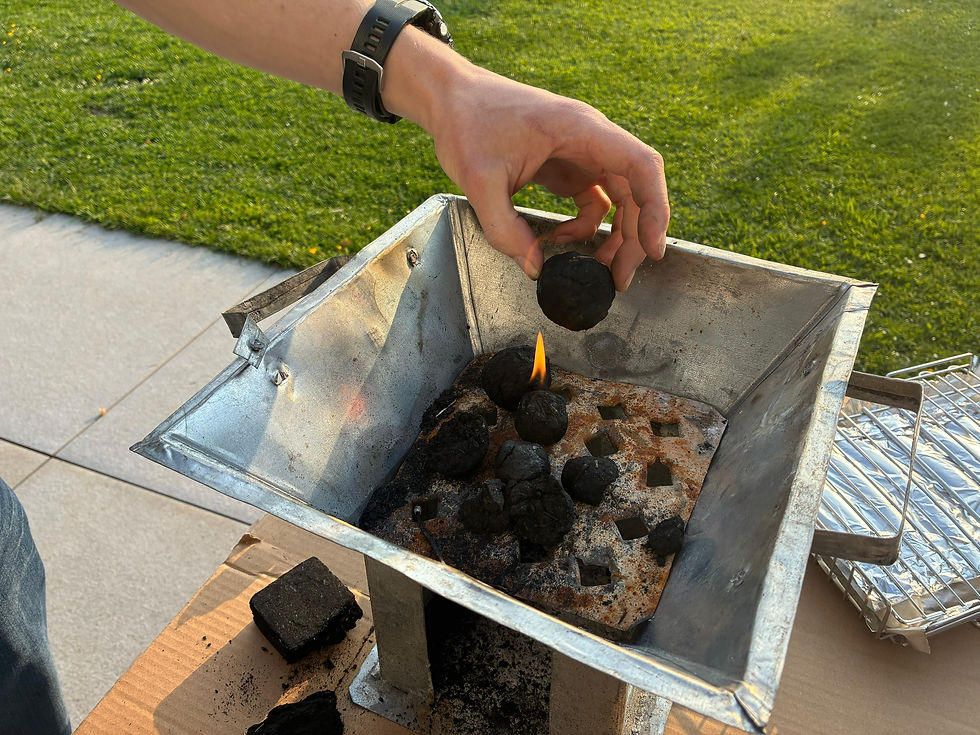
The hay is obviously much finer than wood, and after the carbonisation process, it can be crushed by hand in to a fine powder. In this state, it can't just be put on a stove. So we mix it with water and a binder and either press it or hand shape it in to bricks and balls. Once they are dry, they can be transported and burned similar to wooden charcoal.
In the beginning,
we started with just pressing hay into bricks to increase the energy density and make hay an alternative to wood. Quite quickly, we realised that carbonising it is the better way. Although we lose some of the energy during the process of turning hay in to coal, the end product is behaving much more like the wooden charcoal that the people are used to, with being energy dense, light for transportation and low in smoke. We tried different options, starting with a two-chamber Kiln that creates the heat in the lower chamber that is necessary to carbonise the hay in the upper chamber. Pyrolysis happens at around 400 degrees.


This method partly worked, but we needed to burn a lot of fuel to keep the upper barrel on the temperature that is needed. This simple Kiln setup could be much more efficient if more insulated and built differently, but we found that burning the hay in an open barrel, works better and is even simpler. There is a way to have the hay burning in the barrel but with adding more and more hay on top during the process, the oxygen gets restricted and the burning for the material on the bottom stops. Once the barrel gets too full, any fire that is left, gets extinguished with water. What is left over is carbonised hay now. The challenge with this method is, to find the perfect timing, as from having carbon to only having ashes left, there is a short time window.
So the idea is obvious now, we want to take hay so that no more trees have to be cut down. This has many effects. Normally, unused Grass fields just get burnt down and this mostly caused by the people, without many good reasons as far as we understand. It's so bad, that every four years, a total area as big as the whole Island is being burnt down.
These are long existing fields, but also In the forest areas, that have been cut down, Grass grows now is burnt down too and with it, every small new tree that wants to grow. So now with giving the people a reason to collect the Grass, there is a chance to train the people to do Farmer managed natural Regeneration short FMNR. The goal of this is, to not needing to plant or seed trees but to take what is left with roots and sprouting trees to reforest areas.
Furthermore, we believe we can keep existing production chains intact with them only needing to make small adjustments as example: The person who did cut trees and made charcoal out of it, will now cut grass and make it in to charcoal. The one who transported charcoal for a living, will now transport hay coal and the same with the seller on the market.
So with creating an alternative to charcoal, we believe we have a more sustainable resource for the Malagasy people to cook their food, a reason to not burn down the grass and a chance for forests to regrow without too many changes.
We are quite hopeful and excited about this idea, and we do hope and pray that it will flourish and make a difference in the short and long term.
You can see some of our process documented on this video below.

Comments